Legal Translation: When You Need a Certified, Sworn or Notarized One.
16 July, 2026· Article by Taylor Anderson



A mistranslated word in a contract can cost a company a lawsuit. A missing stamp on an immigration file can send an application straight back to the sender. Legal translation sits in that narrow space where language and law meet, and where getting it wrong carries real consequences. Yet most people only discover how exacting the field is when a court, a consulate or a corporate lawyer hands back their paperwork and asks for something more official. This guide walks through what the work involves, and untangles the three words that cause the most confusion: certified, sworn and notarized.
What legal translation actually involves
Legal translation is the work of rendering contracts, court rulings, statutes, patents, witness statements and official certificates from one language into another without changing their legal meaning. That last part is the hard bit. A general translator can convey the sense of a sentence. A legal translator has to preserve its effect, because the finished text may be read in front of a judge or filed with a government office. Terms that look ordinary carry precise weight. "Shall" is not the same as "will". "Consideration" in a contract has nothing to do with being thoughtful. A translator who treats these as everyday vocabulary can quietly alter what a document obliges people to do.
Certified, sworn and notarized are not the same thing
The three terms describe different things, and countries use them differently. A certified translation comes with a signed statement from the translator or agency confirming the work is accurate and complete. In the United States and the United Kingdom, this is usually what an authority means when it asks for an official version. A sworn translation is produced by a translator who has been authorized by a court or government body, most commonly across continental Europe and Latin America, and the sworn translator's stamp gives the document legal standing on its own. A notarized translation adds one more layer: a notary public verifies the identity of the person signing the certification, though the notary does not check the translation itself. Knowing which one a given office wants saves you from paying twice.
Why the legal system behind a document matters
Part of what makes this work demanding is that legal concepts do not always exist in both languages. A term rooted in one country's law may have no clean equivalent in another, especially when a document crosses between the two great legal traditions. PoliLingua's breakdown of civil law versus common law systems shows how a phrase that is routine in one tradition can be almost meaningless in the other. A good translator does not just swap words. They find the nearest functional equivalent and, where needed, flag the gap. Reference material such as Wikipedia's overview of legal translation notes that this is exactly why the field leans so heavily on specialists with a grounding in law, not language alone.
The documents that almost always need it
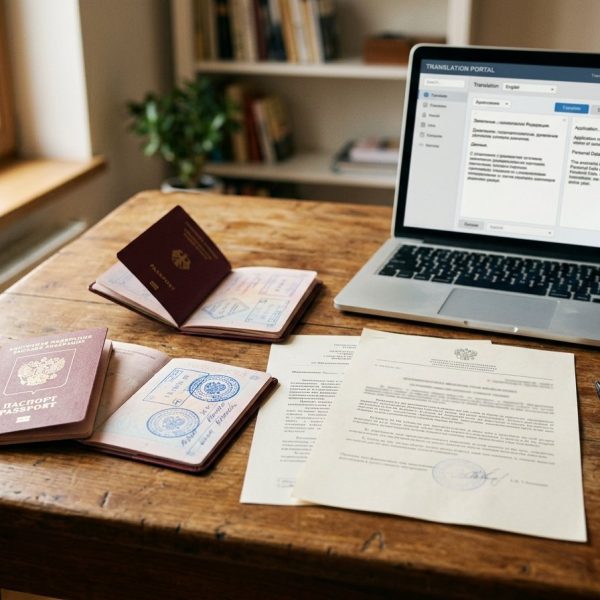
Some paperwork rarely travels without an official translation attached. Immigration files, birth and marriage certificates, academic transcripts, powers of attorney, court judgments and commercial contracts sit near the top of the list. For businesses, cross-border agreements are the usual trigger, and reliable legal document translation is what keeps a merger, a supplier contract or a compliance filing from unravelling over a single disputed clause. The stakes rise with the value of the deal. A person translating a diploma has some room for a small slip. A company signing a multi-year contract across two jurisdictions does not.
Certified work is defined by what the receiving institution will accept, which is a legal question rather than a linguistic one. Commercial content has no such constraint. That difference explains most of the confusion in the localization vs translation discussion, since the two are judged by entirely different tests.
Companies managing cross-border mergers, supplier contracts, and compliance filings cannot afford ambiguity in their paperwork. These high-stakes documents demand precise handling by specialists who understand both legal terminology and jurisdictional requirements. That is why many organizations rely on professional legal translation services.
Where machine translation stops
Automated tools have become genuinely useful for getting the gist of a foreign document quickly, and plenty of legal teams reach for them on a first read. The trouble starts when that draft is treated as final. Machine output carries no certification, cannot swear to its own accuracy, and has a habit of smoothing over the very ambiguities a lawyer needs to see. It will confidently pick one reading of a clause that actually has two. For anything heading to a court, a registry or a signing table, a qualified human still has to stand behind the words. The model most agencies now use is a machine draft followed by a specialist who edits, corrects and certifies, which keeps some of the speed while putting a name and a reputation on the result.
How to choose someone you can trust
Price is the wrong place to start. Ask whether the translator specializes in legal work, which certifications they can provide, and whether they have handled documents for the specific authority you are dealing with. A translator used to immigration filings knows what an office expects, right down to the formatting. Communities of working linguists, such as the r/TranslationStudies forum on Reddit, are full of cautionary tales about cheap jobs that had to be redone. The pattern is consistent: the money saved on the first attempt disappears the moment the document is rejected. When a signature, a deadline or a court date depends on the wording, the safe move is to treat the translation as part of the legal process rather than an afterthought to it. That single shift in mindset is what separates a document that clears the desk from one that comes back stamped and returned.
Recent Posts

How Businesses Lose Money on C...

Resume Translation Services Fo...

Traduzione Curriculum Professi...

Traduccion De Curriculum Profe...
Russian vs Ukrainian Translati...

Le Secteur Du Tourisme Mise Su...
Share it.

We use cookies
We use cookies to give you the best online experience, remember your preferences, and understand how the site is used. You can accept all cookies, reject optional ones, or choose which categories to allow.
Privacy PolicyCookie preferences
Choose which cookies we can use. Necessary cookies stay on because the site cannot work without them.
For more details, read our Privacy Policy.