Russian vs Ukrainian Translation: Why They Differ.
28 August, 2026· Article by Maria Jones

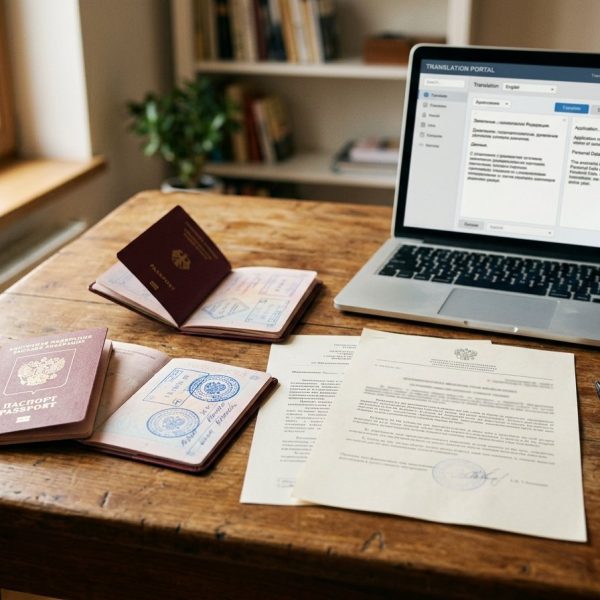
Clients often lump Russian and Ukrainian together as "the same kind of project." They are not. The alphabets look similar, some vocabulary overlaps, and both markets sit in the same part of Europe, but the grammar, the tone conventions, and even the legal terminology diverge enough that a translator fluent in one will still stumble in the other.
This matters more than ever. Companies expanding into Eastern Europe, law firms handling cross-border documentation, and publishers localizing content are all discovering that professional Russian and Ukrainian-language work require separate teams, separate glossaries, and often separate quality checks.
Where Russian Projects Usually Go Wrong
The most common mistake agencies see is treating translation from english to russian as a single-pass job. Russian has a case system with six grammatical cases, and a mistranslated ending can flip the meaning of a sentence in a contract or a technical manual. A second, independent editing pass catches most of these errors, but only if the workflow is built to include one from the start.
Formality is another trap. Russian business correspondence uses a more layered politeness register than English. A message that reads as neutral in English can land as abrupt or even rude once it is translated word for word. Native reviewers who work daily in Russian translation services catch this instinctively, while a generalist translator often misses it entirely.
What Buyers Should Ask Before Hiring
- Does the vendor employ native-speaking linguists based in the target region, not just fluent speakers abroad?
- Is there a dedicated glossary for industry terms, especially in legal, medical, or technical fields?
- Does the workflow include a second linguist for quality assurance, separate from the original translator?
Ukrainian Translation Has Its Own Set of Rules
Since 2022, demand for Ukrainian-language services has surged across immigration offices, hospitals, schools, and government agencies in Europe and North America. Much of that demand centers on ukrainian english translation for personal documents: birth certificates, diplomas, medical records, and legal filings.
Ukrainian has its own dialectal variation, and post-2014 language policy has pushed many official documents further from Russian-influenced phrasing toward standardized Ukrainian vocabulary. A translator who learned Ukrainian a decade ago may still default to older loanwords that now read as outdated or even politically loaded in some contexts. Agencies offering Ukrainian translation services that stay current with these shifts produce documents that read naturally to today's Ukrainian speakers, not to a generation ago.
Beyond the linguistic nuance, ukrainian translation requests increasingly come with a formatting requirement: documents need to match the layout of the source so that clerks and case officers can cross-reference them line by line. That is a production detail, not a language skill, and it is one that smaller freelance operations frequently overlook.
Where CAT Tools Actually Earn Their Keep
None of this happens efficiently without the right production stack. For projects that involve repeated phrasing, such as recurring legal clauses or a product catalog updated every quarter, a cat tool saves both time and consistency. Translation memory stores every previously approved sentence, so once a phrase has been checked by a native reviewer, it does not need to be re-translated or re-checked from scratch the next time it appears.
Treating two closely related languages as interchangeable is one of the more expensive assumptions a business can make. Providers of serious translation services staff the two separately for exactly that reason, because overlapping vocabulary conceals real divergence in usage and register. The distinction matters commercially, not only politically.
Russian and Ukrainian look close enough on the page that non-speakers assume one will substitute for the other, which is precisely where medical translation goes wrong. Dosage, frequency and eligibility instructions are exactly the material that cannot survive an approximate rendering. A guide explaining how often can you donate blood has to be precise in every language it appears in, because the interval is a clinical limit rather than a suggestion.
This is especially valuable for high-volume Russian and Ukrainian projects run in parallel, where terminology needs to stay locked across dozens of documents and multiple translators. Without shared translation memory, two linguists working the same account can quietly drift into using different terms for the same concept, and nobody notices until a client flags the inconsistency.
What a Good CAT Workflow Looks Like in Practice
- A shared glossary that both Russian and Ukrainian teams can reference, even though the languages are handled separately.
- Translation memory segmented by client and by document type, not one giant undifferentiated database.
- A review step built into the editor itself, so quality checks happen inside the same environment as the translation, not in a separate email thread.
Bringing It All Together
Russian and Ukrainian translation both deal with Cyrillic script and a shared regional history, but that surface similarity has led plenty of buyers to underestimate how different the actual linguistic and cultural requirements are. The safest approach is to work with providers who treat each language as its own discipline, staff it with native-region linguists, and back the process with production tools built for consistency at scale.
For background on how the Russian language's grammar and dialects evolved, the Wikipedia overview of the Russian language is a solid starting point for anyone new to the subject.
Whether the need is a one-off certified document or an ongoing stream of technical content, the same principle holds: match the language pair to a team that actually specializes in it, and build the workflow around tools that keep terminology consistent from the first project to the fiftieth.
Recent Posts

How Businesses Lose Money on C...

Resume Translation Services Fo...

Traduzione Curriculum Professi...

Traduccion De Curriculum Profe...

Le Secteur Du Tourisme Mise Su...

Internationale Verträge Brauc...
Share it.

We use cookies
We use cookies to give you the best online experience, remember your preferences, and understand how the site is used. You can accept all cookies, reject optional ones, or choose which categories to allow.
Privacy PolicyCookie preferences
Choose which cookies we can use. Necessary cookies stay on because the site cannot work without them.
For more details, read our Privacy Policy.