How to Choose Interpreting Services for Business Events.
12 February, 2024· Article by Maria Jones


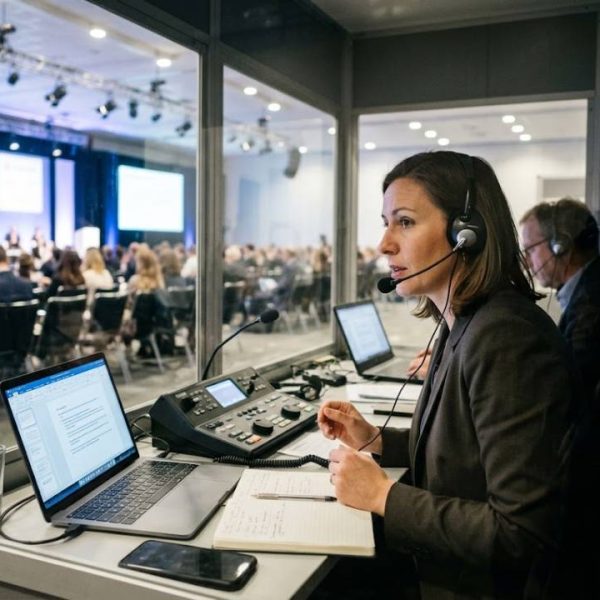
A meeting with partners from another country can succeed or fail on one thing: whether everyone truly understands each other. Good interpreting turns a language barrier into a smooth conversation, while poor interpreting leaves people guessing and decisions delayed.
This guide explains how to choose the right interpreting service for business events, from the type of interpreting to briefing and equipment.
Know the difference between interpreting and translation
Translation deals with written text, while interpreting deals with spoken words in real time. The skills overlap, but they are not the same job.
An interpreter must listen, understand, remember and speak within seconds, often under pressure. That takes training, stamina and a calm approach that few people have naturally.
Being bilingual is not the same as being a trained interpreter. A colleague who speaks two languages may help in a casual chat, but a formal negotiation needs a professional.
Choose the right mode of interpreting
Consecutive interpreting means the speaker pauses so the interpreter can deliver the message. It suits small meetings, interviews and site visits, but it takes roughly twice as long.
Simultaneous interpreting happens almost in real time, usually from a booth with headsets. It is the standard for conferences, board meetings and training sessions with larger audiences.
Whispered interpreting works for one or two listeners in a larger room. Phone and video interpreting cover short calls and remote meetings where travel is not practical.
Match the interpreter to the subject
Language skill alone is not enough. A medical conference, a legal hearing and a software demonstration each use specialist vocabulary.
Ask whether the interpreter has experience in your field, and share the topic early. Specialists prepare terminology in advance and avoid hesitation on key terms.
For business events that need both written and spoken support, a provider offering interpreting services alongside translation can coordinate glossaries, slides and live delivery so everything matches.
Brief your interpreter properly
A good briefing improves results more than almost anything else. Send the agenda, the slides, the names of speakers and a short glossary at least a few days before the event.
Explain the goal of the meeting and any sensitive points. Interpreters who understand the purpose can choose wording with care.
Meet briefly before the session starts if possible. Five minutes to agree on terms and signals can save a lot of confusion later.
Plan the technical setup
For simultaneous work, you need booths or portable equipment, microphones and headsets. For remote events, you need a stable platform that supports separate language channels.
Test everything beforehand, including sound quality and internet connection. A perfect interpreter cannot compensate for a poor audio signal.
Professional associations such as AIIC publish standards on working conditions and team size, which help organisers plan realistic schedules.
Work in teams for longer sessions
Simultaneous interpreting is mentally exhausting. Interpreters usually work in pairs and swap every twenty to thirty minutes to keep accuracy high.
If your event lasts more than an hour, plan for at least two interpreters per language pair. Cutting this corner is one of the most common mistakes organisers make.
Think beyond the event
Language support does not stop when the meeting ends. Follow-up emails, contracts and customer questions often continue in several languages.
This article on multi-language customer support shows how businesses keep conversations consistent after the first contact.
Confidentiality and ethics
Interpreters often hear sensitive information about prices, strategy and personal matters. Choose professionals who work under clear confidentiality rules and impartiality.
Ask about their code of conduct and whether a signed agreement is part of the service. Serious providers answer these questions without hesitation.
Budget and timing
Interpreting fees usually depend on the language pair, the mode, the length of the event and the preparation time. Last-minute bookings and rare languages cost more, so plan early.
Ask what the quote includes: travel, equipment, preparation and cancellation terms. A clear breakdown prevents surprises on the invoice.
Cheaper is not always better. A single mistranslated figure in a negotiation can cost far more than the interpreter ever charged.
Cultural awareness in the room
A skilled interpreter does more than convert words. They notice when a phrase may sound too direct, too informal or confusing in the other culture, and they can advise you quietly before or after the session.
Speak in short, clear sentences, avoid slang and pause between ideas. Your interpreter will deliver a more accurate message, and your guests will follow it more easily.
A simple checklist before you book
Confirm the language pair, mode, date, duration and location. Ask about experience, team size, equipment and the way materials will be handled.
Request a clear quote that lists what is included. With a little preparation, interpreting becomes the quiet help that lets your guests focus on the conversation instead of the language.
Recent Posts

How Businesses Lose Money on C...

Resume Translation Services Fo...

Traduzione Curriculum Professi...

Traduccion De Curriculum Profe...
Russian vs Ukrainian Translati...

Le Secteur Du Tourisme Mise Su...
Share it.

We use cookies
We use cookies to give you the best online experience, remember your preferences, and understand how the site is used. You can accept all cookies, reject optional ones, or choose which categories to allow.
Privacy PolicyCookie preferences
Choose which cookies we can use. Necessary cookies stay on because the site cannot work without them.
For more details, read our Privacy Policy.